


The Weight of a Ring

A delicate gold ring can look substantial in a product photograph. A small pendant can fill an entire phone screen. And two pieces with very different weights and gold content can appear almost identical when photographed against the same white background.
In a physical store, customers can pick them up, compare their proportions and feel the difference. Online, those cues are missing.
That has always been a challenge for jewelry e-commerce. But with gold prices at historically elevated levels and consumers shifting toward lighter, lower-carat and more design-led pieces, the gap between what a product looks like and what a customer understands about it is becoming more important.
The industry is changing what goes into a piece of jewelry. Retailers need to reconsider what goes onto the product page.
Less gold, more money
The latest figures from the World Gold Council reveal a striking contradiction.
In the first nine months of 2026, global gold jewelry consumption fell 19% by weight to 889 tonnes, the lowest level for that period in the Council’s records. Yet the value of those purchases increased 15%, reaching almost $130 billion.
The third quarter tells a similar story: 313 tonnes of jewelry gold purchased, 17% less than a year earlier, while spending increased 2% to $43 billion.
Consumers are paying more, but taking home less gold.
Gold bought as jewelry, worldwide
−19%less gold carried out of the shop
Third quarter 2026, gold jewelry by weight against a year earlier
- Mainland China−22%Spending −4%
- Middle East−22%High prices, geopolitics
- India−20%Spending +16%
- United States−18%Spending flat
- Europe−11%Spending +10%, a record
- Turkey−4%Relatively resilient
Source: World Gold Council, Gold Demand Trends. 2025 value derived from the Council’s 2026 figures and y/y growth.
These numbers do not mean shoppers have stopped wanting jewelry. They show how purchasing behavior is adapting to prices.
Across most regions, including India, China and the United States, the World Gold Council reports a continued preference for lighter pieces, lower gold content and smaller items.
For retailers, the implications extend beyond pricing. When customers buy smaller or lighter pieces, the product’s appearance, dimensions, craftsmanship and styling become increasingly important to how they judge its value.
And that creates a particular challenge online, where the product itself cannot do the explaining.
Jewelry design is adapting. So should the storefront.
The response to expensive gold is not the same in every market.
In China, lightweight Hard Pure Gold jewelry allows designers to create intricate pieces with less material while retaining high gold purity. In India, more consumers are considering lower-carat and stone-set jewelry. In the United States, lighter and lower-carat products have also become more attractive.
The common direction is toward making design, craftsmanship and visual appeal carry more of the product’s value.

This shift is also visible in how large jewelry retailers sell.
In its 2026 financial year, Chow Tai Fook reported that e-commerce accounted for 16.5% of mainland China’s retail sales volume but only 7.1% of retail sales value. Its average online selling price was HK$3,300.
Digital channels are already an important part of the business for lower-ticket purchases, even when physical stores continue to dominate overall sales value.
That makes online presentation especially consequential.
A customer considering a smaller gold pendant may have questions that a conventional product gallery cannot answer:
How large will it look around my neck? Why does this piece cost more than a similar-looking one? Is the difference in gold content, craftsmanship or design? How will it look alongside the jewelry I already own?
These are not simply questions about the product.
They are questions about confidence in buying it.
One ring, six different values
Gold purity is one of the clearest examples of how much information can be hidden behind an apparently simple product photograph.
An 18-carat ring contains 75% gold. A 9-carat ring contains 37.5%. Other metals make up the remainder of each alloy.
That difference affects material cost, weight, appearance and the characteristics of the finished piece.
It can also change what a retailer can offer at a particular price point.
The same band, in six golds
4.0 gthe band weighs
3.0 gof it is gold
$439of gold, at the January to September 2026 price
18 parts gold in 24. The rest is mostly silver and copper.
Consider the same ring design produced in different gold alloys. Its visual identity may stay largely consistent, while the amount of gold it contains (and its underlying material cost) changes substantially.
For a retailer, this creates opportunities to offer different price points without necessarily changing the core design.
For the customer, however, those variations need to be clear.
A label such as “gold ring” is not enough to explain the difference between 9K, 14K and 18K. Neither is a product photo that makes each version appear identical.
How much gold is in gold
Parts per thousand
The lowest standard Britain ever kept. Made legal in 1854 and hallmarked ever since, stamped 9 and .375. France allowed it in 1994, and India brought it into its hallmarking scheme in July 2025.
Purity matters differently to different customers. Someone buying a ring as an everyday accessory may prioritize design and affordability. Someone purchasing gold as a store of value may care much more about purity and weight.
Neither customer should have to search through several tabs or ask customer support to understand what they are buying.
The better the product information, the easier it becomes for customers to make a decision that matches their priorities.
What jewelry websites need to do differently
Changing material costs and lighter designs create several practical challenges for online retailers. We see four areas where the shopping experience deserves particular attention.
1. Show the real size, not just the beauty shot
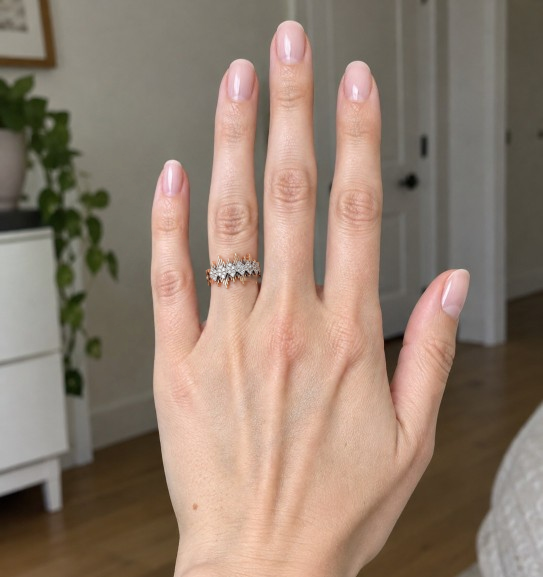
A close-up product photograph is designed to reveal detail. But without a recognizable reference, it can also distort a customer’s perception of scale.
An 8 mm pendant and a 34 mm pendant can occupy the same amount of space in two separate product images. A thin ring can look substantial when photographed alone.
For jewelry, dimensions are not secondary specifications. They are part of how the product looks and feels.
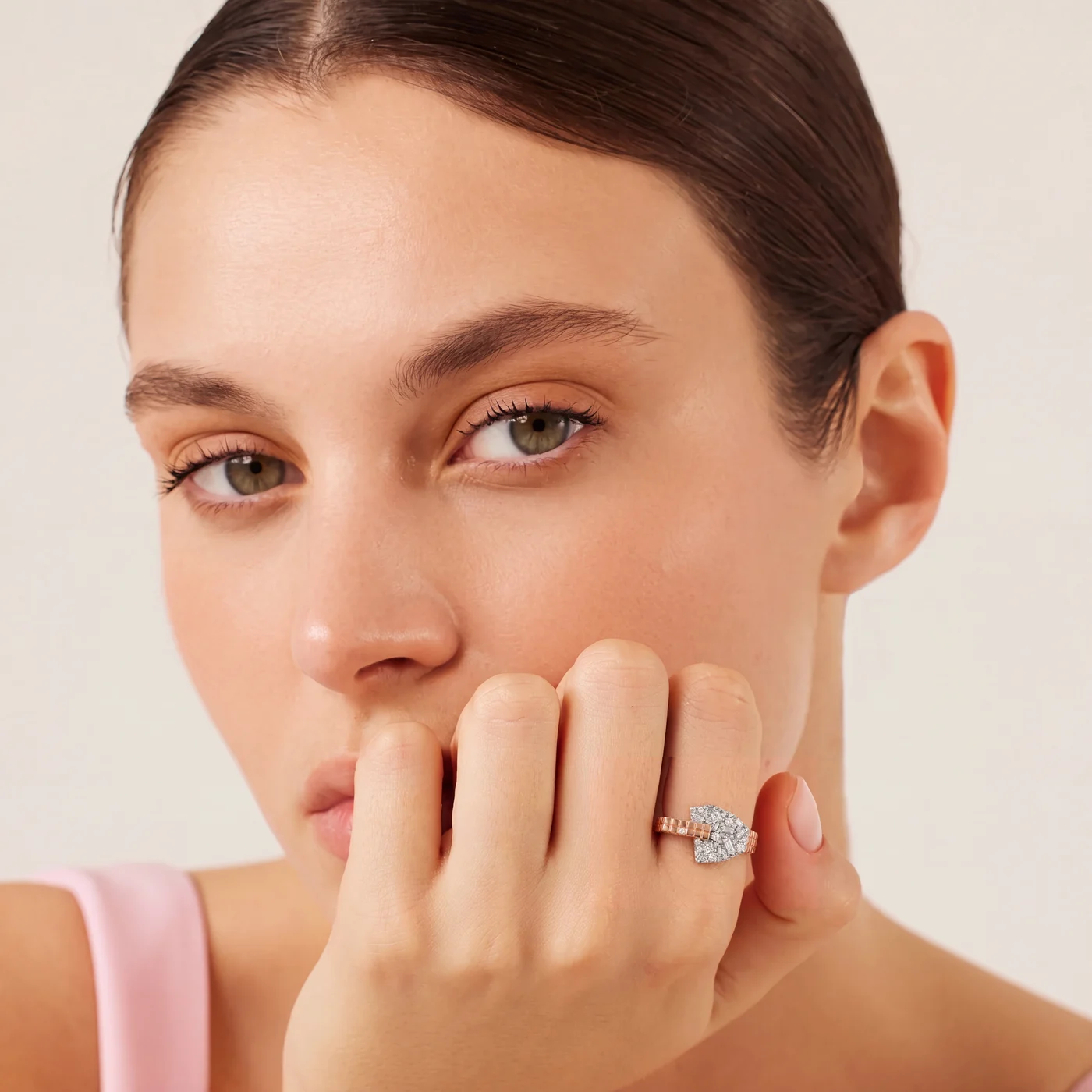
Retailers should make scale visible through model photography, clear millimeter measurements and contextual images.
Virtual try-on offers another way to bridge that gap: allowing shoppers to see a ring, necklace or bracelet on their own photo, represented at its intended dimensions.
This does not replace the physical experience, but it can answer a question a conventional packshot often cannot: How will this actually look on me?
Jewelry Try-OnShows a necklace, ring or bracelet on the shopper’s photo, to scale, so a slim piece looks as slim as it is before they buy.2. Explain what customers are paying for
As gold becomes more expensive, customers may compare products more carefully.
Two necklaces can look similar and have very different prices because of their purity, metal weight, stone settings, construction or craftsmanship.
A product page should make those differences understandable.
Carat, fineness, metal weight, dimensions and material composition should be consistently available as structured product information. Where appropriate, they should also be usable as collection filters.
But specifications alone are not enough.
When a piece commands a premium because of its design, finishing or craftsmanship, the retailer needs to communicate that value through photography, descriptions and product storytelling.
Pricing deserves the same attention.
Brands that price by metal weight may need transparent breakdowns of material, making charges and taxes. Fixed-price brands need a clear internal policy for when changes in gold costs trigger catalog price adjustments.
Gold prices can move in both directions. A pricing strategy should account for both.
The objective is not to turn every product page into a commodity calculator. It is to make the reasons behind the price understandable.
3. Keep the first purchase accessible
High gold prices create a particular problem for brands that depend on bringing new customers into the category.
The first purchase often carries more uncertainty than the second. A customer who has never bought from a jewelry brand may be reluctant to commit to a relatively expensive piece without having experienced its quality.
This makes entry-level assortment strategy especially important.
Depending on the market and the brand’s positioning, lighter designs, alternative carats, vermeil or smaller stone-set pieces can create more accessible ways to enter a collection.
But a lower price should not come at the expense of clarity.
Customers should understand exactly which materials and specifications they are choosing, and why a more affordable option differs from a more expensive one.
The opportunity is not simply to sell cheaper jewelry. It is to make a first purchase easier without undermining the brand’s positioning.
4. Sell combinations, not just individual pieces
Lighter jewelry also creates opportunities in how products are styled and merchandised.
A slim bracelet might be subtle on its own but distinctive when combined with two others. Small earrings may have a stronger visual effect when arranged into a curated ear stack.
Yet most jewelry websites still present these products primarily as isolated items.
The customer has to imagine how they work together.
Retailers can reduce that effort through coordinated product photography, curated combinations and interactive stacking experiences.
An ear stack tool can help shoppers explore the placement and scale of multiple earrings together. A bracelet stack experience can show how different widths and designs work on the same wrist.
These experiences do more than display additional inventory. They help customers evaluate the combination as a whole rather than making several disconnected product decisions.
For retailers, they also create a natural opportunity to introduce complementary pieces and encourage multi-item baskets.
The next advantage is product clarity
Gold prices will continue to fluctuate. Some consumers will respond by buying lighter pieces. Others will choose different materials, purchase less frequently or continue buying high-purity jewelry for its long-term value.
There is no single assortment strategy that will work for every jewelry brand.
But the challenge for online retail is consistent.
Customers need to understand what they are buying, how it will look and why it is worth the price.
A strong product experience should make the material composition clear, represent physical dimensions accurately, communicate craftsmanship and make it easy to explore complementary products.
These improvements are useful regardless of where gold prices go next.
At Alfreya, we build tools that help jewelry retailers close the gap between seeing a product and understanding it, from scale-aware virtual try-on to interactive ear and bracelet stacking.
Because as jewelry changes, the way customers experience it online needs to change too.
